How Is Crypto Taxed? Taxable Events Explained (2026)
Yes, in most countries crypto is taxed. In the US, selling, swapping or spending crypto is a taxable event that can produce a capital gain or loss, and crypto you earn as income, from staking or mining for example, is taxed as income. Buying crypto with cash and moving it between your own wallets are generally not taxable.
Most readers searching this want to know one thing: do I owe tax, and on what? This page uses the US as its main example and notes where other countries differ. It explains structure rather than rates, because rates and thresholds change each year and depend on your income. Check your tax authority’s page for the current year, such as the IRS digital assets page in the US. Rules differ by country; see crypto tax in Australia. India handles crypto differently again; see crypto tax in India.
Do you pay taxes on crypto?
In the US, the IRS treats crypto as property, not currency. That means tax follows the same logic as selling a share or other asset: tax arises when you dispose of it or earn it, not while you simply hold it. Whether you have to pay anything depends on whether you had a gain, how long you held, and your total income.
| Action | Taxable in the US? | How it is treated |
|---|---|---|
| Buy crypto with cash | No | Sets your cost basis |
| Hold crypto | No | No tax while unsold, even if the price rises |
| Sell crypto for cash | Yes | Capital gain or loss |
| Swap one coin for another | Yes | A sale of the first coin at its value that day |
| Spend crypto on goods or services | Yes | A sale at the value of what you bought |
| Move coins between your own wallets | No | Not a sale; keep records |
| Receive staking, mining or airdrop rewards | Yes | Income at fair market value when received |
| Get paid in crypto for work | Yes | Income at value when received |
| Gift crypto | Depends | Rules differ by amount; check IRS guidance |
| Lose crypto to a hack or scam | Complex | Treatment is limited and fact-specific |
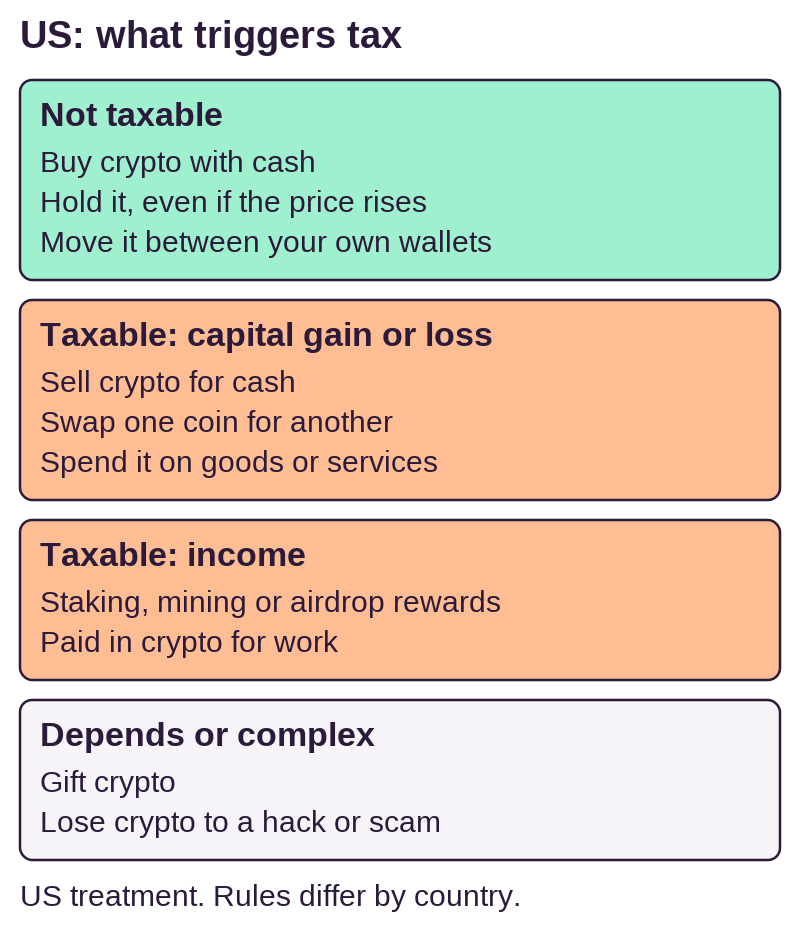
Taxable and non-taxable events, as this page states them for the US.
How crypto gains are taxed
When you dispose of crypto, your gain is the proceeds minus your cost basis. Our guide to cost basis in crypto explains how to work out each figure.
Example: you buy 1 BTC for $30,000 and sell it for $40,000. Your gain is $40,000 - $30,000 = $10,000. If you sell for $25,000, you have a loss of $30,000 - $25,000 = $5,000.
The length of time you held it changes the rate structure in the US:
- Short-term gains apply to assets held one year or less and are taxed at your ordinary income rate.
- Long-term gains apply to assets held more than one year and are taxed at lower, income-based rates. In recent years the federal rates have been 0%, 15% or 20%, depending on income.
So how much is crypto taxed? It depends on your income, how long you held, and where you live. Some US states also add their own tax.
How crypto income is taxed
Crypto you earn rather than buy is income. Staking rewards, mining, airdrops and payment for work are generally taxed at their fair market value on the day you receive them, at ordinary income rates. That value then becomes the cost basis of those coins, so a later sale only taxes the change since receipt.
Losses
A capital loss can offset capital gains. In the US, if losses exceed gains, a limited amount can offset other income, and the rest carries forward. Our page on whether crypto losses are tax deductible goes through the details.
What to report
In the US you report disposals on Form 8949 and carry totals to Schedule D; see our Form 8949 guide. The Form 1040 also asks a digital asset question, and you must answer it. Crypto income goes where other income does. Brokers report gross proceeds on Form 1099-DA for transactions from 1 January 2025 (forms sent in early 2026), and report cost basis for certain transactions from 1 January 2026, according to the IRS. The form does not cover every transaction, such as self-custody and DeFi activity, so keep your own records. For the whole process, see how to file crypto taxes.
Crypto tax software can import your history and calculate this for you. Our Koinly review is one example, and the best crypto tax software list compares others.
How other countries differ
- UK: gains fall under capital gains tax, with same-day and 30-day matching rules and a pooled cost for the rest; check HMRC for current allowances.
- Canada: crypto is generally treated as a commodity, with only part of a capital gain included in income; check the CRA.
- Australia: the ATO treats crypto as an asset subject to capital gains tax, with a 50% discount for Australian resident individuals who held the asset for at least 12 months.
- India: a separate regime applies: a flat 30% tax on gains, 1% TDS on many transfers and no set-off of losses. Check the Indian tax authority’s current rules.
Common questions
Is moving crypto from an exchange to my wallet taxable?
Generally not in the US, because you still own it. Keep a record of the transfer so software does not read it as a sale.
Do I owe tax if I only held and never sold?
Not in the US. Unrealized gains are not taxed until you sell, swap or spend.
What if I made a loss overall?
You may not owe tax on crypto, but you can still report the loss, which can offset gains. Confirm the limits with your tax authority.
This page is general information, not tax advice. Tax rules change, so check with your tax authority or a tax professional before you file. A qualified tax professional can apply the rules to your situation.