What Is Impermanent Loss? How It Works With an Example
Impermanent loss is the gap between what your tokens are worth in an AMM liquidity pool and what they would be worth if you had just held them. It appears when the prices of the pooled tokens move relative to each other, and it is only realized if you withdraw while the gap exists.
If you provide liquidity to a decentralized exchange, you earn trading fees, but you also accept a cost that doesn’t show up in any fee table. That cost is impermanent loss. It is a comparison, not a charge: you are measuring the pool against holding.
Why it happens
An automated market maker keeps a pool balanced by formula. When one token’s price rises on the wider market, traders buy it from the pool until the pool’s price matches. That means the pool sells the rising token as it climbs and ends up holding more of the token that fell. You end up with less of the winner than if you had kept your tokens in your wallet.
A worked example
Example: you deposit 1 ETH and 2,000 USDC into a constant product pool when ETH is 2,000 USDC. Your deposit is worth $4,000. Holding the same tokens outside the pool would be worth $4,000 now.
ETH doubles to 4,000 USDC. The pool rebalances, and your share becomes about 0.707 ETH and 2,828 USDC. At the new price that is 0.707 × 4,000 + 2,828 = about $5,657. Holding would have been 1 × 4,000 + 2,000 = $6,000. The shortfall is $6,000 − $5,657 = about $343, or roughly 5.7% of the held value. That is the impermanent loss, before fees.
The figures above come from the constant product formula and assume a simple full-range pool with no fees; real pools differ.
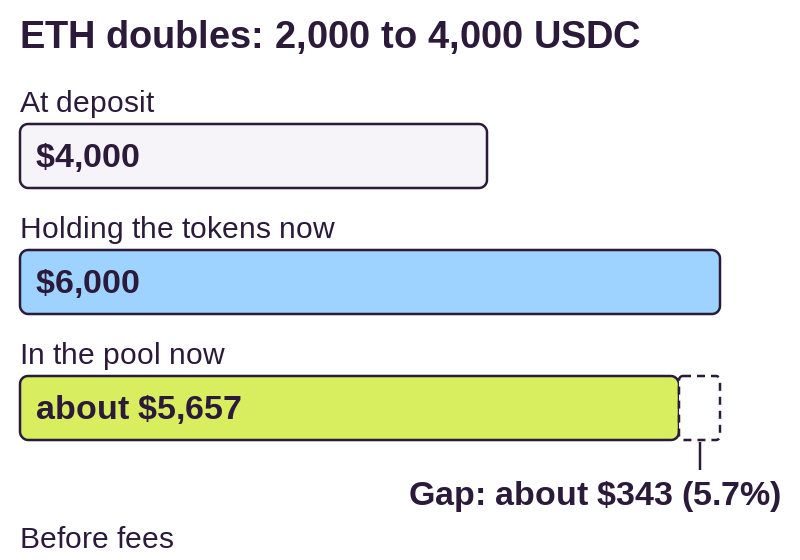
The worked example: pool value against simply holding.
How big can it get?
For a simple constant product pool of two volatile tokens, the loss grows with the size of the price change in either direction:
| Price change of one token vs the other | Approximate impermanent loss |
|---|---|
| 1.25x | 0.6% |
| 1.5x | 2.0% |
| 2x | 5.7% |
| 3x | 13.4% |
| 5x | 25.5% |
The direction doesn’t matter, only how far the relative price moves. Pools of two tokens that move together, such as two dollar stablecoins, have little impermanent loss, though they carry other risks like a depeg.
Why “impermanent”?
If the price ratio returns to where it was when you deposited, the loss disappears. Once you withdraw, the loss becomes real. For many pairs the price never returns, so “impermanent” can be misleading.
Fees can offset it, but not always
Liquidity providers earn a share of swap fees. If fees collected exceed the loss versus holding, you come out ahead. This depends on trading volume, pool fee level and how volatile the pair is. Concentrated liquidity positions, which provide liquidity in a chosen price range, can earn more fees per dollar but can amplify impermanent loss and leave you with a single token if the price leaves your range. The Uniswap guide describes its pool versions.
Other risks for liquidity providers
- Smart-contract risk. A bug can lose funds.
- Rug pulls. A pool with a scam token can be drained, leaving you with a worthless token.
- Token approvals. Adding liquidity needs approvals; approve only the amount you need and revoke old ones.
- Fake front-ends. Use a bookmarked official address, and never enter a seed phrase on a website.
Only provide liquidity with money you can afford to lose.
Estimate your own case
Our impermanent loss calculator turns a price change into an estimate. For the mechanics behind pools, read how liquidity pools work.
Can fees cover the loss? A worked example
Example: in the 2x case above, the loss against holding was about $343 on a $4,000 deposit. On a pool with a 0.30% fee, you need about $343 ÷ 0.003 = about $114,000 of swap volume passing through your share of the pool just to break even on that move. In a busy pool that may take weeks or months, and in a quiet pool it may never happen. A pool with a 1% fee tier needs only about $34,000, but fewer traders may choose it. The figures ignore network fees and tax.
Adding liquidity step by step
- Choose the pool and read its fee tier and recent volume. Volume matters as much as the percentage.
- Open the DEX from a bookmarked official address, as fake front-ends copy liquidity pages too.
- Check the contract address of both tokens from official sources.
- Enter the amount. The app shows how much of each token is needed.
- Approve each token for the amount you need. Avoid unlimited approvals.
- Confirm, then record the value of your deposit and the date, since you need it to measure the loss later.
- When you withdraw, revoke the approvals you no longer need through a block explorer’s approval checker.
What can go wrong
| Situation | What happens | What to do |
|---|---|---|
| One token crashes | You end up holding mostly the falling token | Pick pairs you are happy to hold on either side |
| A concentrated range is left | Your position sits in a single token and earns no fees | Check positions regularly or choose wider ranges |
| Scam token in the pair | The pool is drained | Do not provide liquidity to unknown tokens |
| Stablecoin depeg | A “stable” pair becomes volatile | Read the stablecoin’s reserve and redemption terms |
Common questions
Can you avoid impermanent loss?
Not completely while providing liquidity to volatile pairs. You can reduce it by choosing pairs that move together, or accept it for the fees you expect to earn.
Is impermanent loss a fee?
No. It is an opportunity cost: the difference between pool value and holding value. Network fees and pool fees are separate.
Do stablecoin pairs have impermanent loss?
Very little while both coins hold their peg, because their relative price barely moves. The loss can become large if one of them loses its peg.
Is the loss still there if I never withdraw?
The value gap exists on paper while the price ratio differs from your deposit. It is realized only when you withdraw, but it can also close if the ratio returns.
Do I get impermanent loss if I just hold tokens?
No. Holding in your wallet has no pool to rebalance, so there is nothing to compare against.
Sources
- uniswap.org supports: Constant product pools rebalance as prices move, the source of impermanent loss
- ethereum.org supports: Liquidity provision on decentralized exchanges and its risks