What Is a Stablecoin? How Stablecoins Work and Their Risks
A stablecoin is a cryptocurrency designed to keep a steady value, usually one US dollar per coin. Issuers aim to hold that price by keeping reserves such as cash and short-term government bonds, by locking up other crypto as collateral, or by using an algorithm. Stablecoins let people move dollar-like value on a blockchain, but they can still lose their peg.
Most crypto prices swing widely from day to day. A stablecoin tries to remove that swing, so you can hold or send a token that behaves like a currency. This page explains what stablecoins are, how they keep their price, and where they can fail.
Stablecoin key facts
| What it is | A token on a blockchain that targets a fixed value, most often 1 US dollar |
| Common examples | USDT (Tether), USDC (Circle), USDS (Sky), USD1 (World Liberty Financial) |
| How the value is held | Reserves, crypto collateral or an algorithm |
| Main uses | Trading pairs, moving money between exchanges, sending value abroad, holding dollar value in countries with weak currencies |
| Main risks | Depeg, issuer failure, frozen funds, regulation |
| Is it money in your bank? | No. It is not a bank deposit and is generally not covered by deposit insurance |
How do stablecoins work?
A stablecoin is created, or “minted”, when someone gives the issuer value and receives tokens in return. When they hand tokens back, the tokens are “burned” and they get the value out. That mint-and-redeem loop is what keeps the market price close to the target: if a coin trades below $1, traders can buy it cheaply and redeem it for a full dollar, which pushes the price back up.
That only works if the issuer can really pay out. So the question to ask about any stablecoin is what stands behind it. For more background, see whether XRP is a stablecoin, which covers why XRP, Bitcoin and Ether are not pegged to anything. For more background, see what WLFI is, which covers World Liberty Financial and its USD1 stablecoin.
The three main types
| Type | What backs it | Example approach | Main weakness |
|---|---|---|---|
| Fiat-backed | Cash and short-term government bonds held by a company | USDC and USDT are described by their issuers this way | You rely on the issuer and its custodians |
| Crypto-backed | Other crypto locked in smart contracts, worth more than the coins issued | Sky’s USDS system (formerly Dai from MakerDAO) | Collateral can fall fast; smart-contract bugs |
| Algorithmic | Code that expands and shrinks supply, with little or no real backing | TerraUSD (UST) | Confidence can vanish, and it did in 2022 |
Some newer coins mix these ideas, for example by holding crypto plus offsetting positions. Read how each one describes its backing before you rely on it.
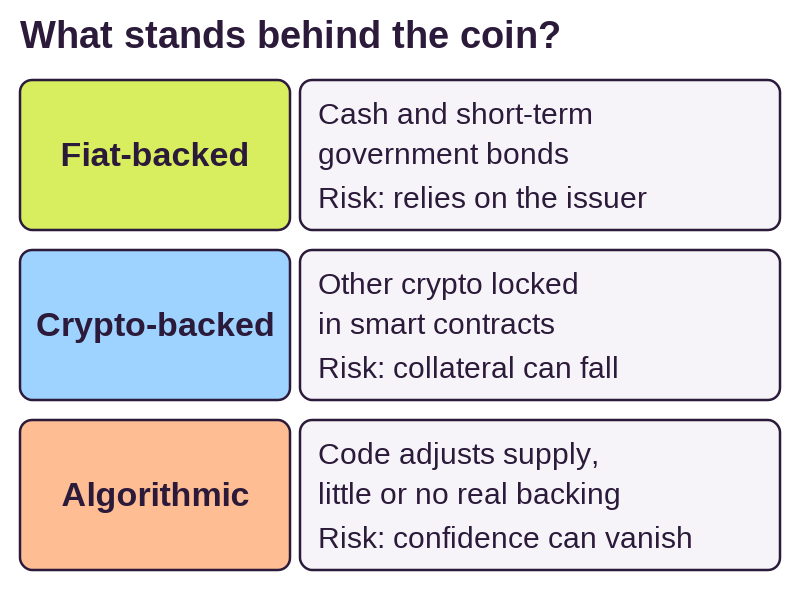
The main stablecoin types, by what backs them.
Why algorithmic stablecoins failed
TerraUSD lost its dollar peg in May 2022 and its sister token collapsed with it, wiping out tens of billions of dollars of value. There was no pile of reserves to redeem against, only a design that depended on buyers staying confident. See how stablecoins go below a dollar for the full pattern. Our page on what Circle is goes into the company that issues USDC and how its reserves are described.
What people use stablecoins for
- Trading. Many exchange markets are quoted in a stablecoin, so it works as the “cash” side of a trade.
- Parking value between trades. Moving into a stablecoin avoids price swings without sending money back to a bank.
- Sending money. A transfer can arrive in minutes at any hour, for a network fee that is often small.
- DeFi. Stablecoins are lent, borrowed and swapped on decentralized finance apps.
- Dollar access. People in countries with unstable currencies use them to hold dollar value.
Risks to know
- Depeg risk. A stablecoin can trade below its target. Some recover; some never do.
- Issuer and reserve risk. If the reserves are smaller, riskier or less liquid than claimed, redemptions can fail. Look for regular, independent reports of what the reserves hold.
- Freezing. Centralized issuers can block specific addresses. Funds held in a frozen address can be stuck.
- Bank and market risk. Reserves held at banks or in bonds are exposed to bank failures and to market stress.
- Rules differ by country. In July 2025 the US passed the GENIUS Act, a federal law setting rules for payment stablecoins. Other countries have their own regimes, and what is allowed where you live can differ. Check current rules and status yourself.
- Scams. Fake tokens use real stablecoin names. Confirm the contract address from the issuer’s own site before you swap.
- Yield claims. A high return on a stablecoin comes from taking risk somewhere, such as lending or leverage. Treat it as a risk decision, not interest on cash.
How to get stablecoins
Most people buy them on an exchange with a bank transfer or card, or swap another coin for them. Our guide on how to buy stablecoins covers the steps, and how to buy USDC covers the most common dollar coin. Only use money you can afford to lose if you are moving into anything other than plain holding. If this topic is new to you, what Sky is explains the protocol formerly known as MakerDAO and its dollar-linked tokens.
Common questions
Is a stablecoin the same as a bank deposit?
No. A stablecoin is a token issued by a company or protocol. You hold a claim on its reserves or collateral, not a protected bank balance.
Why do some stablecoins track the euro or gold?
The target can be any asset. Most track the US dollar because that is what most trading markets use, but euro-pegged and gold-pegged tokens exist.
Can a stablecoin go up in value?
It is designed not to. A fiat-backed coin sitting above $1 usually signals strong demand for redemption or short-term market stress, and arbitrage pulls it back.
Sources
- ethereum.org supports: Types of stablecoins: fiat-backed, crypto-backed and algorithmic; common uses and risks
- congress.gov supports: GENIUS Act, the US federal stablecoin law signed in July 2025