What Is Slippage in Crypto? Causes, Tolerance and How to Reduce It
Slippage in crypto is the difference between the price you expected when you placed a trade and the price at which it actually filled. It happens because prices move and because large orders use up the best offers on the market. Slippage tolerance is the maximum difference you accept before a trade fails.
Slippage is a cost most traders notice only when it is large. It is not a fee that anyone charges you; it is the result of the market moving, or of your own order being too big for the money available at the price you saw.
Slippage at a glance
| What it is | The gap between the expected price and the executed price |
| Direction | Negative slippage (a worse price) is common; positive slippage (a better price) can happen |
| Main causes | Price movement while the order is processed, low liquidity, large order size |
| Where it applies | Centralized exchanges, decentralized exchanges (DEXs) and perpetual futures venues |
| Tool to control it | Limit orders on an order book, or a slippage tolerance setting on a DEX |
| Related costs | Trading fees, network (gas) fees and, on DEXs, the pool fee |
Why slippage happens
- The price moves before your order fills. Crypto trades around the clock and prices can jump in seconds. On a blockchain there is also a delay between you signing a swap and the network including it in a block.
- There is not enough liquidity at your price. An order book lists offers at different prices. A market order, which fills immediately at the best available price, starts with the cheapest offer and works up the book until your order is complete. A larger order reaches more expensive offers, so your average price is worse than the top of the book.
- Pools move with every trade. On a DEX that uses an automated market maker (see what an AMM is), the price comes from the balance of two tokens in a pool. Your trade changes that balance, so a big trade in a small pool moves the price against you. This part is often called price impact, and it is easy to confuse with slippage; the trade interface usually shows both.
- Other traders and bots act first. On a public blockchain, other people can see pending trades. Some bots place orders around yours to profit from the price move, a practice covered in what MEV is.
What slippage tolerance means
On most DEX swap screens you set a slippage tolerance, shown as a percentage. It is the largest price change you will accept between the quote and the fill. If the price moves beyond it, the transaction fails instead of filling.
- Too low and trades fail often, especially in volatile markets, and you may still pay the network fee for the failed attempt.
- Too high and you accept a much worse price, and you give bots more room to profit at your expense.
Example: you swap tokens worth $1,000 with a tolerance of 0.5%. The least you will accept is $1,000 − ($1,000 × 0.5%) = $995 of value. If the market moves so you would only get $990, the swap fails.
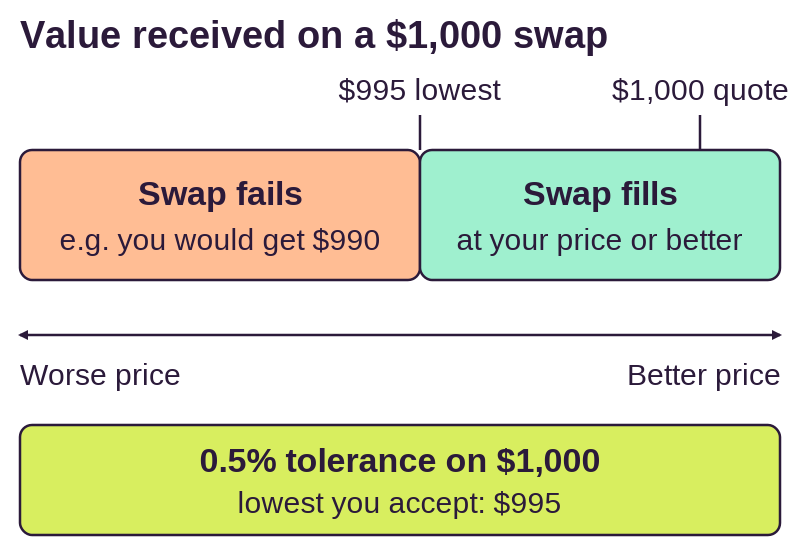
The slippage tolerance sets the worst price you will accept.
How to reduce slippage
- Use limit orders where an exchange offers them. A limit order only fills at your price or better, though it may not fill at all.
- Split large trades into smaller ones, or trade in deeper markets with more liquidity.
- Avoid trading during sharp moves such as major news, when spreads widen and liquidity thins.
- Check price impact before confirming a DEX swap, and be wary of pools with very little liquidity.
- Set a sensible tolerance. Many users start low and raise it only if they understand why a trade keeps failing.
- Stay on liquid pairs. Thinly traded tokens can show large slippage even on small orders.
Slippage on perpetual futures
On a perp DEX such as Hyperliquid, slippage shows up when you place a market order or when a leveraged position is closed or liquidated in a fast market. A liquidation fills at the available price, which can be worse than the price that triggered it. Leverage multiplies this, so a small gap in price can mean a large loss of margin. Only trade with money you can afford to lose.
Safety checks on DEX swaps
Slippage settings are not the only DEX risk. Before you swap:
- Open the app from a bookmarked official address, not from a sponsored search result or a link in a message, because fake front-ends copy real DEXs.
- Read the token approval request. Approve only the amount you need, and review and revoke old approvals periodically with a token approval checker or your wallet’s settings.
- Never enter a seed phrase on a website. See what a DEX is for how self-custody trading works.
What it means for you
Slippage matters most for large orders, thin markets and fast-moving prices. For small trades in big markets it is usually tiny. If you are new to trading, our guide on how to trade crypto covers order types and the costs to check before you start.
Our list of the best DEX aggregators covers tools that route swaps across several venues.
Common questions
Is slippage the same as a trading fee?
No. A fee is a charge set by the exchange or pool. Slippage comes from price movement and market depth, and nobody keeps it as revenue.
Can slippage be positive?
Yes. If the price moves in your favor between the quote and the fill, you can get a better price than expected. Check the swap summary to see what you actually received.
Why did my transaction fail with a slippage error?
The price moved beyond your tolerance before the transaction was confirmed. Retrying with a fresh quote, a smaller amount or a slightly higher tolerance can work, but do not raise the tolerance far above what you need.
Sources
- ethereum.org supports: Decentralized exchanges and automated market makers: swaps priced by pool balances, settled on-chain
- investor.gov supports: A market order is filled immediately at the best available price, which may differ from the last quote