Form 1099-DA Explained: Who Gets It and What It Reports (2026)
Form 1099-DA is the IRS form a digital asset broker uses to report your sales of crypto and other digital assets. Per the IRS, reporting starts with transactions on or after January 1, 2025: gross proceeds for tax year 2025, and cost basis on certain sales from 2026. You report your own gains whether or not you get a form.
Form 1099-DA is new: it is the crypto counterpart of the 1099-B that stock brokers send. The rules changed between tax years 2025 and 2026, so each point below names its year. The most common mistake with it is treating the proceeds it shows as profit; the worked example below shows why they are not.
Form 1099-DA at a glance
| Question | What the IRS says |
|---|---|
| What is it? | “Use Form 1099-DA to report digital asset proceeds from broker transactions.” |
| Who files it? | A broker: someone who “stands ready to effect sales of digital assets to be made by others.” Generally only a U.S. digital asset broker must report. |
| Who receives it? | The broker’s customer. A filer must provide a statement to the recipient. |
| From when? | Transactions on or after January 1, 2025. |
| Tax year 2025 | Gross proceeds from sales. |
| Tax year 2026 and later | Gross proceeds, plus cost basis for covered sales. |
Who files Form 1099-DA
The filer is a broker. The IRS broker FAQ says a digital asset kiosk operator is treated as a type of broker and “must file a Form 1099-DA and furnish your customer an associated payee statement” for sales. The same FAQ describes a custodial business that does not execute sales for its customers as having no reporting obligation in the facts it gives. Whether a platform counts as a broker depends on what it does, so ask the platform. See how Coinbase, Robinhood, Gemini and Crypto.com describe their tax forms.
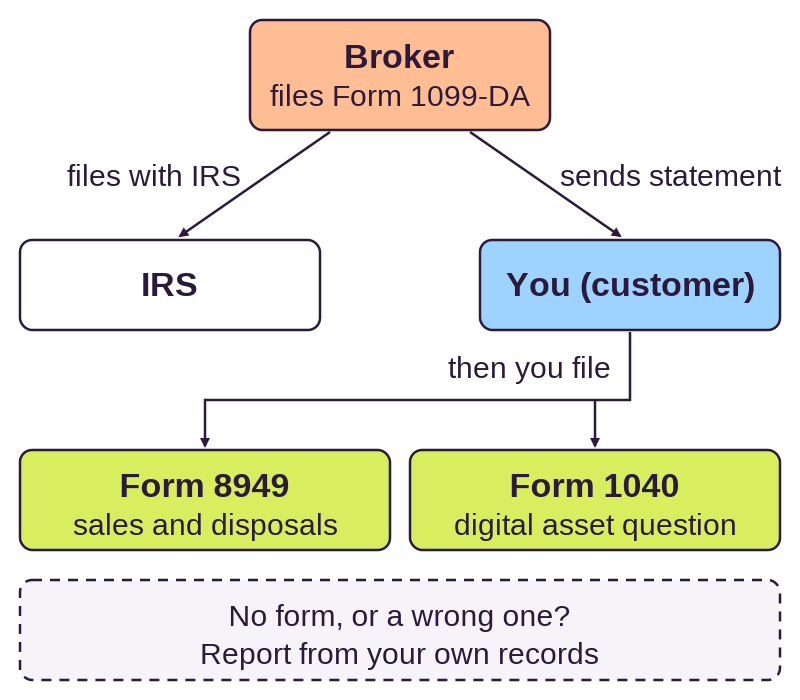
Who sends Form 1099-DA, to whom, and what you then file.
Which tax years report proceeds and which add cost basis
- Tax year 2025. The IRS says broker reporting applies to transactions “on or after Jan. 1, 2025.” The 2025 forms report gross proceeds. The IRS also granted penalty relief under Notice 2024-56 for calendar year 2025 transactions reported in 2026.
- Tax year 2026 and later. The IRS says brokers must report basis on certain transactions starting in 2026. Under the 2026 instructions, a digital asset is a covered security “only if it was acquired in an account for which the broker provided custodial services.” Assets acquired before 2026 are among the noncovered ones. For noncovered assets the broker is not required to report basis, though it may do so voluntarily and check box 9.
For tax year 2025, and for anything you bought before 2026, expect to rely on your own records for cost basis. Our guide to cost basis in crypto covers how to work it out.
What the boxes on Form 1099-DA mean
The 2026 filer instructions describe these boxes. Layouts can change by year, so read the labels on your own form.
| Box | What it shows |
|---|---|
| 1a and 1b | The digital asset’s token code and its name |
| 1c | Number of units sold |
| 1d | Date acquired (blank if the units were acquired on various dates) |
| 1e | Date sold or disposed of |
| 1f | Proceeds: gross proceeds reduced by digital asset transaction costs |
| 1g | Cost or other basis (may be blank for noncovered assets) |
| 2 | Checked if the basis was reported to the IRS |
| 4 | Federal income tax withheld (backup withholding) |
| 6 | Whether the gain or loss is short-term or long-term, and whether any part may be ordinary |
| 9 | Checked if the asset is a noncovered security; boxes 1d, 1g and 6 may then be left empty |
| 11a to 11c | Used only under the optional reporting methods for stablecoins and NFTs |
| 12a and 12b | Units transferred into the account, and the transfer-in date |
| 14 to 16 | State information |
Example: proceeds are not your gain
Say you bought 1 ETH for $1,000 in 2023 on a US exchange and sold it on the same exchange in June 2025 for $3,000, with no fees.
What the 2025 form shows. Box 1f shows $3,000 of proceeds. The cost basis box can be empty: the 2025 forms report gross proceeds, and an asset bought before 2026 is noncovered, so the broker does not have to report its basis.
What you report. You held the ETH for more than a year, so the sale goes in Part II of Form 8949 (long-term), with box K checked, because the 1099-DA did not report basis to the IRS. Enter $3,000 in column (d), proceeds, and your $1,000 basis from your own records in column (e).
Example: gain in column (h) = $3,000 − $1,000 = $2,000.
Had you held it for a year or less, the same figures would go in Part I with box H checked.
A blank cost basis is not a zero cost basis
The 2025 Form 8949 instructions say to figure gain or loss by subtracting the cost or other basis in column (e) from the proceeds in column (d), then taking any adjustment in column (g) into account. If you copy only what a 2025 form shows and leave column (e) empty, the whole sale price looks like gain.
Example: with column (e) left empty, column (h) would show $3,000 − $0 = $3,000, which is $3,000 − $2,000 = $1,000 more gain than you made.
How the IRS says to report it:
- Use the digital asset boxes. Boxes G, H and I apply to short-term sales and J, K and L to long-term ones. Digital assets don’t go in boxes C or F.
- Pick the box by what the form shows. G or J: the 1099-DA shows a basis. H or K: it shows no basis, or says basis wasn’t reported to the IRS. I or L: you didn’t receive a Form 1099-DA.
- Enter your own basis. For a noncovered asset with no basis shown, enter the correct basis in column (e).
- Fix a wrong basis with code B. If the form shows a basis that is incorrect, the instructions explain adjustment code B in column (f) and the amount in column (g).
- Keep the records that prove your basis: purchase confirmations, transfer records and exchange statements.
Why you might not get one
The instructions give optional small-sale rules. A broker may skip designated sales of qualifying stablecoins if a customer’s aggregate gross proceeds do not exceed $10,000 for the year, and specified NFTs if they do not exceed $600 for the year. Processors of digital asset payments have a $600 threshold, above which all of that customer’s sales must be reported. The $10,000 figure applies only to qualifying stablecoins, not to crypto in general.
A missing form does not remove your duty. The IRS FAQ says you “must report income, gain, or loss from all taxable transactions involving digital assets,” whether or not you receive a payee statement.
When forms arrive
For tax year 2025, the IRS general instructions give February 17, 2026 as the date for furnishing Form 1099-DA statements to recipients. Filing with the IRS was due March 2, 2026 on paper and March 31, 2026 electronically. For tax year 2026, check the current IRS general instructions for information returns.
What to do if the form is wrong
- Compare it with your records. Check dates, assets, proceeds and any basis the broker shows.
- Ask the broker for a corrected statement. Under the IRS general instructions, a filer that made an error furnishes a corrected statement to the recipient. Ask through the platform’s support route.
- Report from your own records. The IRS FAQ says gains and losses are reportable whatever a form shows.
- Keep notes. If your return differs from the form, a written reason helps if the IRS asks.
Where it goes on your return
Digital assets are property for U.S. tax purposes. Sales and other disposals go on Form 8949, as our page on Form 8949 for crypto explains. The IRS FAQ notes an exception where your broker has provided a 1099-DA with gross proceeds and basis information. Every Form 1040 also asks a yes or no digital asset question. For the full process, see how to file crypto taxes and how crypto is taxed. Importing exchange histories into crypto tax software can help you reconcile your own numbers with the forms you receive.
The IRS says it does not require digital asset registration and does not send letters with QR codes asking you to register crypto on a “compliance portal”. Treat such messages as scams.
This is general information, not tax advice. Confirm your situation with the IRS or a qualified adviser, such as the kind described in how to choose a crypto tax accountant.
Sources
- irs.gov supports: Form 1099-DA reports digital asset proceeds from broker transactions; 2025 correction notice on de minimis rules
- irs.gov supports: Who must file, gross proceeds, covered and noncovered securities, box meanings and optional de minimis rules (2026 instructions)
- irs.gov supports: 2025 Form 8949: digital asset boxes G to L, entering basis in column (e) when none is shown, code B, how column (h) gain is figured
- irs.gov supports: Reporting starts for transactions on or after January 1, 2025; basis from 2026; Form 1040 digital asset question; Form 8949
- irs.gov supports: You must report all taxable digital asset transactions even without a form; specific identification and records
- irs.gov supports: Broker reporting FAQ: reporting begins with transactions on or after January 1, 2025; kiosks
- irs.gov supports: Tax year 2025 due dates for Form 1099-DA statements and corrected statements