DEX vs CEX: Differences, Fees, Custody and Risks
A CEX (centralized exchange) is a company that holds your funds and matches trades on its own systems. A DEX (decentralized exchange) runs on a blockchain, and you trade from your own wallet. A CEX is easier and offers support and fiat payments; a DEX gives you custody but puts safety and mistakes on you.
Both let you swap one crypto asset for another. The difference is who sits in the middle: a company, or a smart contract. That one choice changes custody, fees, risk and what happens when something goes wrong.
DEX vs CEX at a glance
| CEX (centralized exchange) | DEX (decentralized exchange) | |
|---|---|---|
| Custody | The exchange holds your assets | You hold them in your wallet |
| Account | Sign-up, usually with identity verification | Usually a wallet connection; the app’s own terms may restrict some users |
| Paying with a card or bank | Commonly supported | Usually crypto only; a separate on-ramp is needed |
| Price source | Company order book | AMM pool or on-chain order book |
| Fees | Trading fee, plus deposit and withdrawal fees set by the exchange | Trading fee plus the network (gas) fee |
| Support | Help desk and account recovery | None that can reverse a transaction |
| Typical failure | Hack or insolvency of the company; frozen account | Wrong approval, fake site, scam token, contract bug |
| Tokens available | What the exchange chooses to list | Anything someone puts in a pool, including scams |
| Privacy | The company knows your identity | Transactions are public on the blockchain |
Custody: the biggest difference
On a CEX you hold an IOU. The company can freeze withdrawals, and if it fails you can become a creditor. On a DEX your wallet signs each trade and you keep the keys, so no company can freeze your balance, but if you lose your seed phrase or sign a malicious transaction, no one can restore it. “Not your keys, not your coins” is true, and so is its flip side: your keys, your responsibility. If this topic is new to you, DeFi versus traditional finance explains the differences in custody, access, protection and risk.
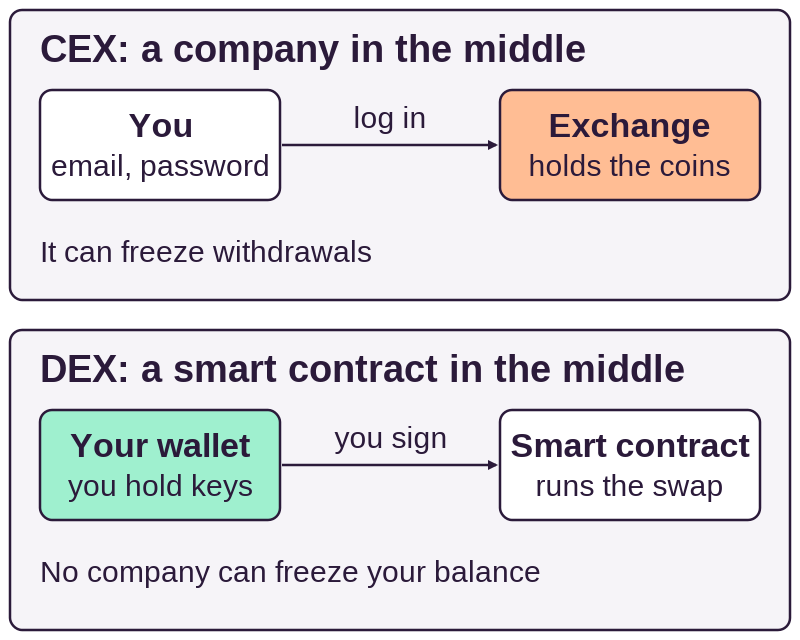
Who holds the coins on a CEX and on a DEX.
Fees and speed
Both charge a trading fee. A CEX adds its own withdrawal fee; a DEX adds the blockchain’s network fee, which rises when the chain is busy. Read crypto exchange fees explained and what gas fees are to see how each is built. Price quality differs too: a DEX quote can slip between signing and settlement, while a large CEX order book usually holds up better for big orders in major pairs. Compare actual quotes on both for your trade. For more background, see how to use dYdX, which covers the deposit, trading and withdrawal steps on that perpetuals exchange.
Which one suits you?
- A CEX may suit you if you are buying your first crypto with a card or bank transfer, want customer support, or want one place for fiat, trading and storage. Start with our best crypto exchanges.
- A DEX may suit you if you already use a self-custody wallet, want to trade tokens that are not listed on exchanges, or want to use DeFi apps. First read what a DEX is.
- Many people use both: a CEX to turn cash into crypto, and a wallet plus DEX to use it on-chain.
Risks of each
CEX risks: exchange hacks and insolvency, account freezes, withdrawal limits and regional restrictions.
DEX risks: slippage and bad fills, token approvals that stay open until revoked, fake front-ends, rug-pull tokens, and smart-contract bugs. A DEX also does not make leverage safer: on perpetual futures venues such as Hyperliquid, a position can be liquidated and the margin lost. Only trade with money you can afford to lose.
Whichever you pick, reach the app from a bookmarked official address and check the web address before you sign in or connect a wallet.
Example: the same swap on both
Example with made-up rates, only to show how the costs are built. You swap $1,000 of one token for another.
| Cost | On a CEX | On a DEX |
|---|---|---|
| Trading fee | 0.10% = $1.00 | 0.30% pool fee = $3.00 |
| Network fee | None for a trade inside the exchange | Gas, paid in the chain’s native token, varies with traffic |
| Price impact | Small for a major pair with a deep book | Depends on pool size; can be several percent in a thin pool |
| Getting funds in or out | Possible withdrawal fee | Your own wallet, so no withdrawal step, but you need gas |
The real rates differ by exchange and pool. Compare the actual quote and fee line on each before you trade.
Making your first DEX swap: safety steps
- Open the DEX from a bookmark of its official address. Fake front-ends look the same and ask you to sign a transfer.
- Connect your wallet and check which network it is on.
- Pick the token by its contract address from an official source, not by name alone, because scam tokens copy names.
- Read the quote: expected amount, price impact and minimum received. Slippage tolerance is the largest price move you accept before the swap fails. Keep it low unless the token is very thin.
- The first time you spend a token, the wallet asks for a token approval. Choose the amount needed for this swap instead of unlimited when your wallet allows it.
- Afterwards, revoke approvals you no longer need using a block explorer’s approval checker. Revoking costs a small network fee.
If something goes wrong
| Situation | CEX | DEX |
|---|---|---|
| Withdrawal blocked | Contact support; more verification may be needed | Not applicable, but a congested chain can delay it |
| Sent to the wrong network or address | Support sometimes helps, not always | Usually unrecoverable |
| Fake site or phishing | Account takeover; use two-factor authentication and the official app | Wallet drained by a signature; revoke approvals and move remaining funds to a new wallet |
| Token will not sell | Rare, as the exchange chooses listings | Possible with scam tokens |
Common questions
Can I use a DEX without identity verification?
Many DEX apps only ask you to connect a wallet, but each app’s terms can still restrict some countries, and you may need a CEX or on-ramp to buy crypto with a card or bank transfer in the first place. Rules on identity checks vary by country.
Is a DEX always cheaper than a CEX?
No. A DEX adds network gas and, in thin pools, price impact, while a CEX may charge less per trade but add a withdrawal fee. The cheaper option depends on trade size, the chain and the pair.
Which one is safer for a beginner?
Each has different failure modes: a CEX can fail or freeze your account, and a DEX can lose you money through a wrong signature or a fake site. Whichever you pick, start with a small amount and use two-factor authentication on the exchange or a hardware wallet with the DEX.
What does it mean when a DEX asks me to approve a token?
It is a permission for a smart contract to move that token from your wallet, up to an amount you allow. It stays active until you revoke it, so check the amount before you sign.
Sources
- ethereum.org supports: How decentralized exchanges work as DeFi applications with self-custody wallets