Maker vs Taker Fees: What They Mean and How to Pay Less
A maker fee is charged when your order sits on the order book and is filled later; a taker fee is charged when your order fills immediately against an order already there. Takers usually pay more, because they remove liquidity that makers add. A limit order that rests on the book is typically a maker order; a market order is a taker order.
Most crypto exchanges that use an order book charge two different rates on each trade, and the label depends on how your order interacts with the book, not on who you are. Knowing which side of the book you are on is the quickest way to cut your fees. Futures venues use maker and taker fees as well; see how to trade crypto futures in the US.
Maker vs taker at a glance
| Maker | Taker | |
|---|---|---|
| What your order does | Adds a resting order to the order book | Fills immediately against an order already on the book |
| Usual order type | Limit order that doesn’t fill straight away | Market order, or a limit order priced to fill at once |
| Effect on the book | Adds liquidity | Removes liquidity |
| Fee | Usually lower, sometimes 0% or a rebate | Usually higher |
| Fill | Not guaranteed; the price may never reach your order | Immediate, at the best available prices |
How maker and taker orders work
An order book is a list of buy orders (bids) and sell orders (asks) waiting to be matched. When you place an order, one of two things happens:
- Your order is matched at once. If you place a market order, or a limit order with a price that crosses the best offer on the other side, it fills against orders already waiting. You are the taker.
- Your order waits. If you place a limit order at a price the market hasn’t reached, it joins the book. When someone else’s order later fills against it, you are the maker.
An order can be split. A large limit order may partly fill straight away as a taker and leave the remainder on the book as a maker. Many exchanges offer a “post-only” option that cancels your order instead of letting it fill as a taker.
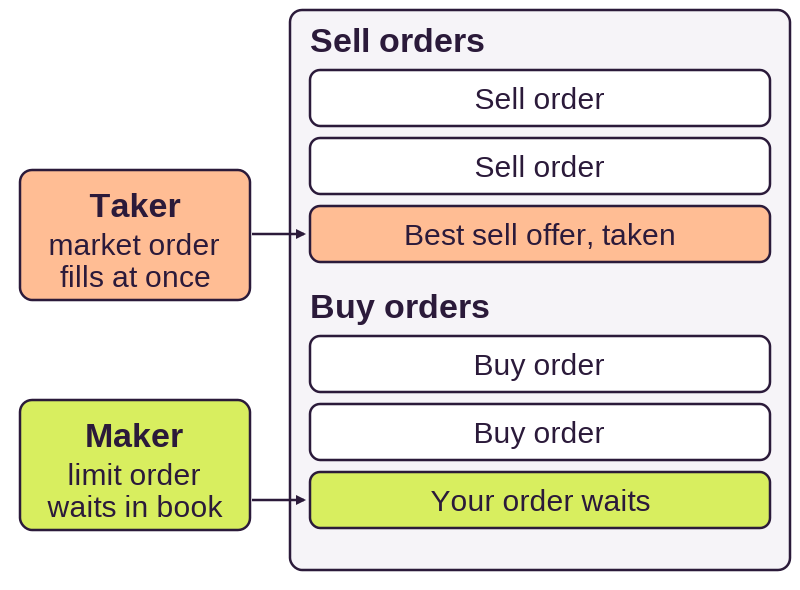
A taker fills against the book; a maker adds to it.
Why exchanges charge makers less
Order books need orders resting on them so other people can trade quickly at fair prices. Makers supply them. Exchanges lower or remove the maker fee to encourage that, and some high-volume tiers pay makers a rebate. Takers get speed and certainty, and pay for it.
A worked example
Rates differ by exchange and by tier, so these are illustrative figures only, not any exchange’s rates.
Example: you buy $1,000 of a coin with a maker rate of 0.10% and a taker rate of 0.20%. As a taker, the fee is $1,000 × 0.20% = $2. As a maker, the fee is $1,000 × 0.10% = $1. Repeated over many trades, the gap adds up.
The cheaper maker order has a cost too: it may not fill, or may fill only if the price moves to you. If the market moves away, you can miss the trade entirely.
A worked example on a real order book
Suppose a coin’s order book shows the best bid at $99.90 and the best ask at $100.10. You want to buy 10 coins. Rates are hypothetical: 0.10% maker, 0.20% taker.
| Choice | What happens | Cost |
|---|---|---|
| Market order | Fills at once near $100.10, so about $1,001. You are the taker. | Fee about $1,001 × 0.20% = $2.00 |
| Limit order at $100.10 | The price touches the best ask, so it fills at once. You are the taker. | Same $2.00 fee |
| Limit order at $99.95 | Joins the book above the best bid. It fills only if sellers come down to you. You are the maker. | Fee $999.50 × 0.10% = about $1.00 |
The maker order saves about $1.00 in fees and gets a price $0.15 per coin lower, so about $1.50 less on 10 coins. The price you pay for that is waiting, with no promise of a fill. If the price rises to $101 and never returns, you buy nothing, and the missed move costs more than the fee you saved.
Steps to place a maker order
- Open the advanced or pro trading screen, not the simple buy button.
- Choose Limit as the order type.
- Enter an amount and a price that does not cross the other side of the book. For a buy, that means a price at or below the best bid or just under the best ask.
- Tick post-only if the option is shown, so the order is rejected rather than filling as a taker.
- Check the fee preview, if shown, and submit. The order appears under open orders until it fills or you cancel it.
What can go wrong
- The order never fills. The price moved away. Decide in advance how long you will wait before changing the price or cancelling.
- A partial fill. Only part of your amount traded. The rest stays open, and you pay maker fees only on what filled as a maker.
- A post-only rejection. The price crossed the book. Move it back from the best price and resubmit.
- A hidden spread. On simple buy screens you pay a spread and a fee in one price, so the maker discount never applies.
Maker and taker fees on simple buy screens
Simple “buy” and “convert” buttons in exchange apps usually don’t show maker and taker rates. They quote one price that already includes a spread plus a fee. Maker and taker rates appear on the pro or advanced trading screen. For a look at how this plays out, see how Coinbase fees and Kraken fees separate the two products.
How to pay less in maker and taker fees
- Use limit orders when you aren’t in a hurry, so you can be a maker.
- Use post-only orders if your exchange offers them and you want to be sure of the maker rate.
- Raise your volume tier. Most exchanges lower both rates as your 30-day volume rises, and some count balances too.
- Pay with the exchange token where the exchange gives a discount, remembering that holding it adds price risk.
- Compare total cost, not only the headline rate. Spreads, slippage and withdrawal fees matter. See what slippage is.
To compare real rates, see the lowest-fee crypto exchange table and crypto exchange fees explained. For a head-to-head, see Kraken vs Coinbase.
For a worked example on one platform, see Coinbase Advanced trading fees.
Common questions
Is a maker order always cheaper?
On exchanges that charge maker and taker rates, usually. A few charge the same rate to both, and promotions can change it. Check the fee page.
Do I pay a taker fee on a market order?
Yes, because a market order fills immediately against the book.
Does a limit order guarantee the maker rate?
No. If your limit price crosses the book, it fills at once and you pay the taker rate.
Sources
- investor.gov supports: Definition of a market order: buy or sell immediately at the best available price
- investor.gov supports: Definition of a limit order: buy or sell at a specified price or better